
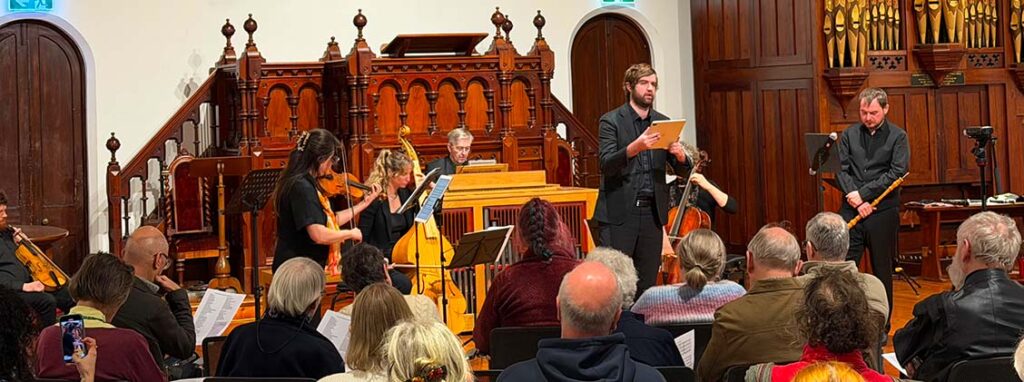
Tenor – Timothy Reynolds
Baritone – Lachlan McDonald
Violin & Viola d’amore – Shane Lestideau
Oboe & Oboe d’amore – Kailen Cresp
Traverso – Greg Dikmans
Violin – Stephanie Eldridge
Violin and Viola – Dovi Hanner
Cello – Rosanne Hunt
Violone – Reidun Turner
Keyboard – David Macfarlane
The felicitous inspiration for the MBO’s 3rd concert of this year’s series is right there in the title. A tiny, and rarely performed, portion of Bach’s vast output of cantatas features obbligato instrumental solos for viola’d’amore or oboe d’amore. As it happens, the only vocal soloists required are a tenor, a bass, or both. The requirement for a chorus only in the closing chorales was ingeniously catered for by printing the music in the program and inviting audience participation, a promising approach for many cantatas where this is the only choral element.
The first cantata, Ich armer Mensch, ich Sündenknecht, BWV 55 (Bach’s only cantata just for solo tenor), opened with a delicious interplay of pairs of winds and strings, offsetting the angst-ridden but lyrical vocal line. Timothy Reynolds has an ideal tenor voice for Bach, intense but controlled even in the high register, and with clear and expressive diction, in evidence in the two varied recitatives. Between them came an aria with an obbligato for the instrument which, if not “d’amore”, is familiar to all lovers of Purcell as “the am’rous flute” – and in the hands of the national treasure of the traverso, Greg Dikmans, it was of course played with supreme mastery.
Next the versatile Shane Lestideau showed off the sonorities of the viola’d’amore in two movements of Vivaldi’s Concerto in D, RV 392, a wide-ranging Allegro and a delicate Largo revealing the serene bloom given by the instrument’s sympathetic strings.
The initial duet of Ich lasse dich nicht, du segnest mich denn!, BWV 157, is a sumptuous piece of ensemble writing, its unusual instrumentation treated to a ravishingly beautiful performance.The following extensive aria exposed tenor and oboe d’amore to great challenges, which they both made seem effortless. Kailen Cresp has taken a deep interest in various members of the Baroque oboe family, with wonderful results. In the final aria the bass soloist has to shift midstream to recitative, arioso, adagio etc. All this was handled with great aplomb, and a rich, supple voice, by Lachlan McDonald, who was – though one would never have known it – a late replacement due to illness.
After interval the mood was lightened with Telemann’s Concerto in E for Viola d’amore, Oboe d’amore & Flute, TWV 53:E1. This is a work which displays passages of exquisite charm in the slow movements, exploiting the refined instrumentation – exquisitely performed here. But it also has, as is Telemann’s wont, some more rustic moments, not to say slightly bonkers – also performed in the appropriate spirit.
The solo bass cantata Der Friede sei mit dir, BWV 158, has two expressive recitatives framing an Aria con Corale. Here the simple chorale melody was played by the oboe d’amore, while the lovely valedictory melody of the bass voice, again beautifully sung, was set amid a filigree violin obbligato finely played by Stephanie Eldridge. All were supported by the ever-reliable MBO continuo group.
For a cheerful close the group turned to the more conventional instrumentation of the duet Wie will ich mich freuen from Cantata BWV146. It was a rousing finale for the whole ensemble, and a reminder that there are special instruments worth hearing more of, and special voices worth hearing more of too.
There are indeed many works, even by J. S. Bach (and also by many others), that well deserve a hearing, and few could do better than the MBO at remedying this, both in the planning and the execution.

Richard Excell is a retired librarian (formerly Rare Music Cataloguer at the University of Melbourne), musicologist and player of vielles, rebec and gemshorn. He is a longtime member of the medieval ensemble Acord, and researches many of their concerts. Together with his wife Bev he is a collector of early editions and manuscripts, with a focus on choral music.
Make a tax-deductible donation today. Your support enables us to plan with confidence and pay our musicians well.
Support us
Melbourne Baroque Orchestra acknowledges the sovereignty of the people of Boon Wurrung and Woi Wurrung language groups of the Eastern Kulin Nations on whose unceded lands we perform and share our love of music. We acknowledge their Ancestors and Elders past and present.